


Benefits of Outsourcing Medical Billing and Claims Processing
In the 2026 medical practice environment, we usually come across practice owners complaining they are busier than ever, and yet their bottom line does not change.
The US medical practice is stuck between the complete adoption of AI-based payer-imposed claims rejection and the administrative burden of revised compliance requirements. If you see your employees drowning in paperwork rather than working on patient care, then you are experiencing the burden of an unproductive revenue cycle.
It’s time you think about the strategic benefits of outsourcing medical billing. In this blog, we will explain why outsourcing is necessary for you. Let’s start
What are Medical Billing Services?
Fundamentally, medical billing services involve the complete revenue cycle management process. This begins the time when the patient refers to an appointment and terminates when the balance reaches zero. It consists of patient registration, insurance verification, medical coding (with the now-crucial complexities of revised ICD-11 coding), submission of claims, posting of payments, and aggressive follow-up of denied or underpaid claims.
Billing has been confused with data entry by many providers. In truth, it is an expert financial procedure. Outsourced medical billing companies use the best possible RCM (Revenue Cycle Management) software and certified coder teams to make sure that the services that you provide are reimbursed at the highest rate possible to you, and you do not have to spend too much time between service rendered and payment received.
Who Should Outsource Medical Billing Services?
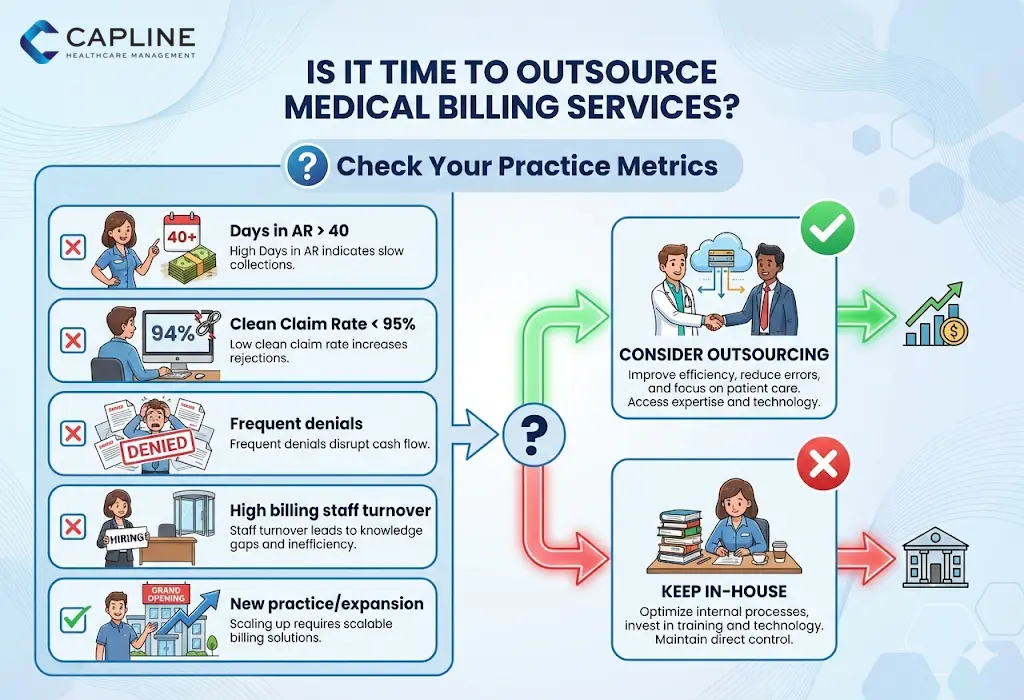
Not all practices have to outsource immediately, but there are red flags that you should not ignore. You will have to consider taking a billing partner when:
- Your Days in AR (Accounts Receivable) exceed 40 days: This is an indicator of stagnant revenue.
- Your Staff Turnover is High: It may be more expensive to keep training billing clerks each time than to have the service outsourced.
- You are Opening a New Practice: You can outsource medical billing services and concentrate on the clinic without administrative debt.
- You Have Frequent Denials: When your clean claim rate is less than 95, then your in-house staff is probably not coping with the existing payer regulations.
Benefits of Outsourced Medical Billing Services
A decision to outsource your medical billing services is no longer about reducing expenses but a strategic decision to future-proof your practice. Here are outlined the four major advantages of outsourcing billing for a competitive advantage.
1. Financial Benefits: Maximizing the Bottom Line
The first and most immediate effect of the decision to outsource the medical billing is recorded in your bank account. The cost of in-house billing is quite high: salaries, benefits, payroll taxes, office space, and the exorbitant cost of enterprise-level billing software are a significant burden that goes unnoticed.
- Less Overhead: You will cut administrative salaries that are fixed as the company transitions to a variable cost model (which usually involves paying a percentage of collections). The practices cut their overheads by up to a huge percentage in the first six months of operation, outsourcing in the healthcare industry.
- Better Clean Claim Rates: Professional billers eat and breathe claim requirements. According to a Nov. 19, 2024, MGMA Stat survey, over one-third (36%) of medical practice executives believe their organization would automate or outsource a portion of their revenue cycle management in 2025.
- Reduced Reimbursement Pauses: Specific RCM teams resolve claims on a daily basis. With an in-house employee, you will find that the employee will be diverted to assist the front desk or attend to a patient, and in the process, they will fail to finish the AR cycle. Thus, an outsourced team just has a single role of reducing your AR cycle.
- Regular Cash Flow: When your in-house biller is away vacationing or on sick leave, then your billing stops. A service provider will never have a team that does not make sure that your claims are sent out within 24 hours.
2. Operational Benefits: Scalability and Technology
With a healthcare outsource billing company, you are able to access the large capabilities of the so-called Big Tech at a non-Big Tech cost.
- Advanced Analytics: The majority of providers now provide real-time dashboards that can display the location of every dollar. The most underestimated aspect of outsourcing is transparency, as you can check your performance metrics 24/7.
- Scalability: Let’s say you hire a new doctor or establish the second facility; your billing partner scales with you immediately. You do not need to have three new individuals and acquire new desks; you just have to change the size of the contract you already have.
- Technology Access: It is costly to stay abreast of EHR integrations and AI-based billing tools. Outsourcing companies carry that burden, and they will be supplying you with the latest technology, which is included in their package.
3. Compliance & Risk Management: Staying Ahead of Audits
The regulatory environment in 2026 is unforgiving. As more attention is paid to the issue of upcoding and medical necessity by the Department of Justice and the OIG, compliance is an enormous burden for individual doctors.
- HIPAA and Cybersecurity: Healthcare data breaches hit their peak at the end of 2025. A good billing partner offers higher security, such as enterprise-grade encryption and 24/7 security monitoring, that most small practices cannot afford alone.
- Periodic Audits: It has been found that professional firms conduct internal audits on your coding before your code is submitted to the payer. This decreases your red flag profile to external audits.
- ICD-11 Experience: With the shift to more specific coding still in progress, you want to make sure that you have certified experts who will not leave you losing because of some vague coding, which will initiate a denial.
4. Clinical & Staff Benefits: Reclaiming the Joy of Medicine
The hidden benefit of outsourcing in the healthcare industry is the regaining of practice culture. Nowadays, a great number of office managers and nurses are overwhelmed with tasks that they are expected to complete with regard to billing, which takes them away from patients.
- Less burnout: Your employees can work on the patient experience, like scheduling, rooming, and patient care, and do not have to engage with insurance companies on the phone.
- Patient Satisfaction: When the billing is done in a professional manner, patient statements are correct and clear to read. This results in the reduced number of complaints and the improved overall reputation of your practice.
- Provider Focus: In the case of the physician, it translates into less time at the desk and at home to fix EHR codes and more time helping people, which is the purpose of entering medicine.
Comparison Table: In-House vs. Outsourced Billing (2026)
| Feature | In-House Billing | Outsourced Billing (RCM Partner) |
| Direct Costs | Salaries, Benefits, Training, Tech | Percentage of Collections (Variable) |
| Average AR Days | 45 – 60+ Days | 28 – 35 Days |
| Transparency | Dependent on Staff Reporting | 24/7 Real-Time Cloud Dashboards |
| Compliance Risk | Practice bears 100% responsibility | Shared liability; Expert oversight |
| Staffing Issues | Hiring/Training/Retention issues | Continuous coverage; No downtime |
| Software Updates | Costly & Manual | Included & Automatic |
Conclusion
In conclusion, the benefits of outsourcing medical billing extend far beyond simple cost-cutting. If you are in search of a billing partner, then look no further. Capline is all you need to outsource medical billing services. Contact us today!
People Also Ask
1. What best practices ensure a smooth transition when outsourcing medical billing?
Go for a data migration plan that involves tailing off your old AR as the new vendor begins fresh claims, which should be given priority. It is suggested that there be a 30-day transitional period.
2. What are the key performance indicators for outsourced medical billing?
You should track Net Collection Rate (aim for >96%), Days in AR (aim for <35), and First-Pass Clean Claim Rate (aim for >95%). A quality partner will provide you with monthly reports on these specific metrics.
3. What are the downsides of outsourcing medical billing?
The primary concern for many is a perceived loss of control and the risk of variable costs increasing as your revenue grows. However, these are usually mitigated by choosing a partner that offers full transparency and a clear, tiered pricing structure.
4. Which is the best medical billing service provider in the USA?
The “best” provider depends on your specialty and size; look for vendors that specialize in your specific field (e.g., cardiology vs. mental health).
5. What services are included in medical billing outsourcing packages?
Standard packages typically cover claim submission, denial management, payment posting, patient billing, and basic RCM reporting.
6. What does the medical billing outsourcing contract typically cover?
A standard contract covers the scope of services, fee percentages, data ownership, and HIPAA business associate agreements.
7. What data security measures are expected from billing service providers?
At a minimum, expect multi-factor authentication for all users. They should also provide a clear breach notification protocol in their contract.
8. What onboarding timeline should providers expect for new vendors?
Most practices can expect a full transition within 30 to 60 days. This includes software integration and staff training on new intake workflows.
9. What exit strategy planning is needed before outsourcing medical billing?
Always ensure your contract has a clear “data portability” clause. This ensures that if you decide to leave, the vendor must return all patient and billing records in a usable format within a specified timeframe.
10. How do providers monitor outsourced medical billing performance daily?
Providers should use a cloud-based portal provided by the vendor to view real-time “work-in-progress” queues.