

What is a Legacy Number in Medical Billing?
Have you ever sat at your desk and looked at a claim rejection out of an old file and wondered why a perfectly valid National Provider Identifier (NPI) is not sufficient? You are not alone.
We have watched dozens of practice managers lose sleep because of the problem of legacy billing, which should have been forgotten a decade ago. However, in the complex healthcare administration environment, history can tend to remain pertinent. Understanding the legacy number meaning is not just a trip down memory lane, but it's a vital skill for resolving stubborn claim denials and passing audits.
This is a guide to the US doctors and healthcare practices in the transition from old systems to new systems. When you go through this blog, you will know precisely what a legacy number is and where it is still used.
What is a Legacy Number in Medical Billing?
Have you ever sat at your desk and looked at a claim rejection out of an old file and wondered why a perfectly valid National Provider Identifier (NPI) is not sufficient? You are not alone. We have watched dozens of practice managers lose sleep because of the problem of legacy billing, which should have been forgotten a decade ago. However, in the complex healthcare administration environment, history can tend to remain pertinent. Understanding the legacy number meaning is not just a trip down memory lane, but it's a vital skill for resolving stubborn claim denials and passing audits.
This is a guide to the US doctors and healthcare practices in the transition from old systems to new systems. When you go through this blog, you will know precisely what a legacy number is and where it is still used.
What is a Legacy Number in Medical Billing?
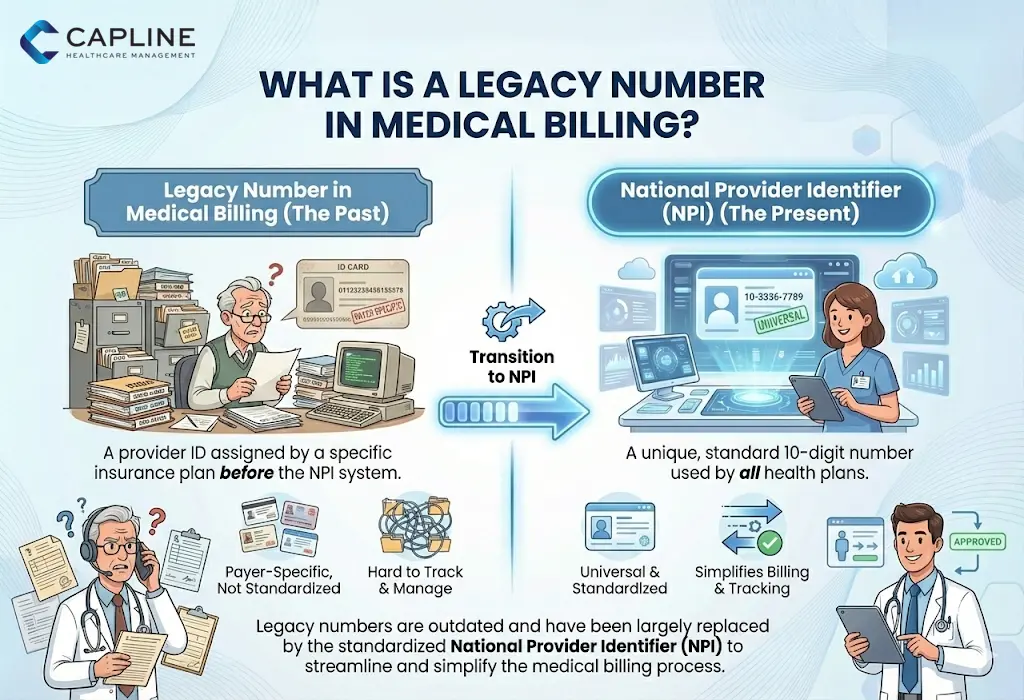
Prior to the mid-2000s, it was not the case of one number to rule them all. Rather, all insurance payers, be it Medicare, Medicaid, or Blue Cross Blue Shield, provided their own unique identification numbers to providers. This is the core legacy number, meaning it is a payer-specific identifier used before the universal adoption of the NPI (National Provider Identifier).
The doctors of 2004 did not simply have an ID. You had a Medicare UPIN (Unique Physician Identification Number) and a different Medicaid number in each state where you practice, and other commercial IDs. These were the statistics of a disjointed system. While the NPI was mandated by HIPAA to simplify this, these older identifiers didn't just vanish; they became "legacy IDs" that still exist in historical databases and certain state-run programs.
At Capline, our team’s deep expertise in medical billing compliance helps practices bridge the gap between outdated identifiers and modern NPI-based workflows.
What is a Legacy ID?
In everyday language, "legacy number" and "legacy ID" are used interchangeably. But when we discuss what a legacy ID is in the modern context, we are typically referring to any non-NPI identifier that a payer needs to be cross-referenced with.
On a claim form, a legacy provider ID may be mandated, e.g., when you are billing a secondary insurance that has not yet updated its internal database to connect your NPI to your original contract. These are the old fingerprints of your practice within the system of the payer.
Where is the Legacy Number Written on Medical Billing?
When you are viewing a typical CMS-1500 form, you will not be able to find a box with a clear label of Legacy Number. It is in the shaded areas created to hold additional information.
- Box 24J (Highlighted Area): This is where the legacy provider ID occurrence is the highest. Although the NPI is placed in the bottom segment of the box, the legacy identifier is commonly placed in the upper shaded section.
- Boxes 32b and 33b: The boxes are used to identify the Other ID of the service facility and billing provider, respectively. In case a payer needs a legacy billing number, this is the field where your biller will type the qualifier (such as 0B State License Number or 1G Provider UPIN) and then the legacy number itself.
What is the Use of Legacy Number in Medical Billing?
So you may ask, now that we have NPIs, why do we still bother with legacy billing? In this case, three main reasons are present:
- Historical Claim Research: In the case of a look-back audit or research of an insurance claim that has been made several years prior, the NPI may not be the key in the old system. Those records are unlocked with the legacy number.
- Medicaid Details: There are numerous state Medicaid programs that continue to use an internal provider tracking number that is the Medicaid legacy number, even where the NPI is present on the claim.
- Payer Enrollment: In credentialing with a new group or re-validating with one of the old ones, the payer might request your "Legacy ID" to tie your new NPI-based profile to your past billing history.
Key Aspects of Legacy Numbers
In order to master the legacy number meaning, you must be aware of these five key components:
- Payer Specificity: Aetna provides a legacy number that would never be accepted by a Cigna claim.
- Qualifier Codes: If you are making an electronic billing (837p transactions), you cannot simply send a number. You have to send a qualifier code (such as G2 or LU) to enable the system to understand what legacy number you are submitting.
- Historical Accuracy: Claiming a legacy number in 2024 whose value is that of 1998 will be almost certainly denied by the result of a mismatched identifier.
- Transition Mapping: Payers apply so-called crosswalks to translate your NPI to your old legacy numbers. In case this crosswalk is broken, the payments cease.
- Medicaid Legacy Number: In some systems of state Medicaid systems, the provider must still use a legacy ID in 2026 when an NPI cannot be assigned to him or her (such as some home-care specialists).
Conclusion
In Medicare, the use of legacy numbers in day-to-day billing has been virtually eliminated; this is not the case in Medicaid. Due to the fact that Medicaid is run by states, not all states have been timely in upgrading their back-end systems.
During enrollment, a Medicaid legacy number is likely to be necessary. Although you do not enter that number in the CMS-1500 form, that number is the account number of your practice in the treasury system of the state. In case your biller accidentally enters an old legacy ID that was inactivated in a 2022 revalidation, you will get a suspended claim instead of a denied claim, again more difficult to track.
Need help navigating a surge in Medicaid denials? Contact our RCM Audit Team here for a workflow review.
FAQ
1. What is a legacy identifier?
A legacy identifier is an outdated code, like a PTAN or UPIN, used pre-NPI to identify providers in billing systems. It's key for historical reference.
2. What is legacy medicaid?
Legacy Medicaid refers to old state-specific provider or client numbers before NPI standardization. States like Texas transitioned them during system updates for continuity.
3. What are all the different types of numbers in medical billing?
In medical billing, common ones include NPI (national standard), PTAN (Medicare legacy), UPIN (physician legacy), OSCAR (facility legacy), Medicaid state IDs, and group numbers. Each serves for identification or tracking.
4. What is a legacy provider?
A legacy provider is one enrolled under old systems, using pre-NPI IDs. Today, it means providers with historical records needing linkage to current NPIs.
5. What is the difference between legacy and NPI?
Legacy IDs are payer-specific and varied (e.g., alphanumeric), while NPI is a universal 10-digit number. Legacy was replaced for efficiency but remains for audits.
6. Why legacy numbers were replaced by NPI?
Fragmentation caused errors; HIPAA mandated NPI for standardization, reducing admin burdens. Implementation cut costs but required legacy mapping.
7. How to find an old Legacy number for historical claim research?
Check NPPES, PECOS, or state portals like lamedicaid.com. Old enrollment letters or payer remits often list them—I've used these in audits.
8. Can a provider have multiple legacy numbers but only one NPI?
Yes, legacies varied by payer/location (e.g., one per state Medicaid), but NPI is singular and national.
9. Do legacy numbers ever expire, or do they just become inactive?
They become inactive post-NPI but don't expire. They're queryable for historical purposes, per CMS guidelines.
10. How can I verify a provider when only a legacy ID is available in old records?
Use CMS's NPPES search or payer portals to crosswalk the legacy to NPI. For Medicare, PECOS links them directly.